

Table of Contents
- Why Buying Bulk Premium Kitchen Towels Makes Sense
- Commercial Kitchen Towel GSM Guide: What Thickness Really Means
- Wholesale Paper vs Fabric Kitchen Towels: Which Lasts Longer?
- Finding Reliable Wholesale Kitchen Linen Suppliers
- What to Look for in Premium Bulk Kitchen Towels
- Bulk Buying for Households vs Businesses: Getting the Quantities Right
- Conclusion
- Frequently Asked Questions
Last Updated: September 20, 2026
Why Buying Bulk Premium Kitchen Towels Makes Sense
Buying bulk premium kitchen towels is the single most effective way to cut what a busy kitchen spends on paper while raising the quality of what you actually use. At Leaora, we manufacture kitchen towels in Britain from 100% virgin pulp parent reels, so we see first-hand how much households and commercial kitchens waste on small, thin packs. When you buy bulk premium kitchen towels, you buy fewer, better rolls that do more per sheet, and you stop paying a convenience premium every fortnight.
The logic is simple: a kitchen towel that absorbs properly means you reach for fewer sheets per spill. A towel that tears cleanly means less waste. Multiply that across a family of five or a 40-cover restaurant and the difference in consumption is significant.
Below, we break down GSM, fabric versus paper, supplier checks and quantities so you can order once and order right.
Commercial Kitchen Towel GSM Guide: What Thickness Really Means
GSM stands for grams per square metre, and it is the clearest signal of a kitchen towel's weight and durability. A commercial kitchen towel GSM guide matters because two towels can look identical on the shelf yet perform completely differently once wet.
How GSM Affects Absorbency and Strength
Higher GSM generally means more fibre per sheet, which translates into greater absorbency and wet strength. A heavier towel holds more liquid before it saturates and resists tearing when you wring it out. Lower-GSM towels feel flimsy and shred under a full cup of spilled liquid.
That said, GSM is not the only variable. Fibre quality and ply count matter just as much. A 3-ply towel made from virgin pulp will outperform a heavier recycled sheet because the fibres are longer and interlock better.
GSM Ranges for Different Kitchens
| GSM Range | Typical Use | Feel |
|---|---|---|
| 18-22 GSM | Light domestic wiping | Thin, single-use |
| 24-28 GSM | Everyday household kitchens | Moderate, decent wet strength |
| 30-40 GSM | Commercial kitchens, heavy spills | Thick, high absorbency |
| 40+ GSM | Industrial and catering | Very heavy, cloth-like |
For most homes, 24-28 GSM is the sweet spot. For commercial use, start at 30 GSM and work up.
Wholesale Paper vs Fabric Kitchen Towels: Which Lasts Longer?
Fabric kitchen towels last far longer per unit, but paper towels win on hygiene and convenience for most kitchens. The honest answer depends on what you are cleaning.
Fabric towels, usually cotton or linen, survive hundreds of washes. A wholesale kitchen linen supplier will sell you a set that lasts years. The trade-off is laundry: you need to wash, dry and store them, and a dirty cloth sitting damp on a counter breeds bacteria fast.
Paper towels are single-use, which makes them the safer choice around raw meat, grease and food prep surfaces. You use it, you bin it, and there is no cross-contamination risk.
Here is the practical split most kitchens settle into:
- Fabric towels for drying hands, glassware and polished surfaces
- Paper towels for spills, grease, food prep and sanitising
- Both in a commercial kitchen, with colour-coded cloths for different zones
For bulk buyers, paper usually wins on total cost of ownership once you factor in the water, detergent and labour that fabric requires.
Finding Reliable Wholesale Kitchen Linen Suppliers
A reliable wholesale kitchen linen supplier does three things well: consistent stock, clear specification sheets and a backup plan when demand spikes. Everything else is marketing.
Leaora operates a UK-based tissue converting factory using precision 1400mm semi-automatic rewinding machinery, which means we control the finish on every roll rather than reselling someone else's stock. That control is what keeps a supply chain dependable when others wobble.
Questions to Ask Before You Commit
- What is the GSM and ply count, stated in writing?
- Is the pulp virgin or recycled, and where is it sourced?
- What is the minimum order quantity, and does it scale down for small buyers?
- What is the lead time, and what happens if an order is delayed?
- Can you provide a sample before I commit to a bulk order?
- What is the returns policy if a batch arrives damaged?
What to Look for in Premium Bulk Kitchen Towels
Premium bulk kitchen towels share four traits: a stated GSM, a virgin pulp base, clean perforations, and consistent sheet size. Check each before you buy.
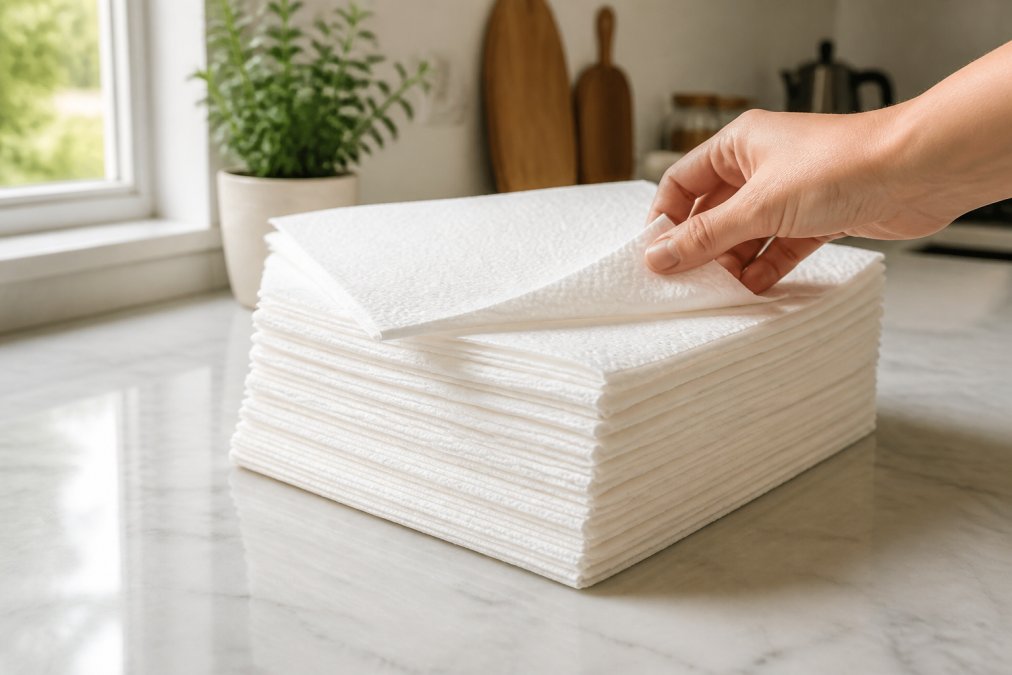
Start with the specification. Any serious supplier will tell you the GSM, ply and sheet count without hesitation. If they cannot, walk away.
Next, check the perforations. Poorly cut perforations tear raggedly and waste half a sheet every time. Precision rewinding, the kind Leaora uses on its 1400mm machinery, produces a clean edge that separates exactly where you want it.
Then test absorbency in practice. Drop a sheet onto a spill and watch how quickly it draws liquid. A quality towel saturates in seconds and holds together when lifted.
Finally, confirm the finish is consistent across the pack. Uniform roll density and sheet size mean you get the same performance on roll one and roll forty-eight.
Bulk Buying for Households vs Businesses: Getting the Quantities Right
Households and businesses need very different order sizes, and getting this wrong is the most common bulk-buying mistake. Over-order and you store rolls for a year; under-order and you pay delivery charges twice.
For a household of four, a 24 to 48-roll case typically covers three to six months. That is enough to justify bulk pricing without turning your spare room into a warehouse.
For a commercial kitchen, work backwards from daily usage. Count how many rolls you get through in a week, multiply by the lead time, then add a buffer of roughly two weeks. That buffer is your safety stock.
| Buyer Type | Typical Order | Reorder Cycle |
|---|---|---|
| Single household | 24-48 rolls | Every 3-6 months |
| Large household | 48-96 rolls | Every 4-6 months |
| Small office | 48-72 rolls | Every 2-3 months |
| Commercial kitchen | 96+ rolls | Monthly |
Conclusion
Getting bulk buying right comes down to matching GSM, material and quantity to how you actually use your kitchen. Buy too thin and you waste sheets; buy too many and you waste space.
Leaora manufactures premium kitchen towels in Britain from 100% virgin pulp parent reels, sold direct from our factory with a dependable supply chain and a consistent finish on every roll. If you want bulk kitchen towels that hold up in a busy home or a working kitchen, choose Leaora and order with confidence.
Frequently Asked Questions
What is the difference between commercial-grade and domestic kitchen towels?
Commercial-grade kitchen towels are built for frequent washing and heavy use, often with higher GSM and reinforced edges. Domestic towels prioritise softness and appearance. For busy kitchens, commercial-grade bulk kitchen towels last longer and absorb more before needing replacement. Check the GSM and construction before buying.
How do I choose the right GSM for premium kitchen towels?
GSM indicates density and absorbency. For everyday household use, 400-500 GSM works well. Busy commercial kitchens benefit from 500-600 GSM or higher for better spill control and durability. Higher GSM means thicker, more absorbent towels, but they take longer to dry. Match GSM to your typical workload and drying capacity.
Is it cheaper to buy kitchen towels in bulk for small businesses?
Buying in bulk usually lowers the cost per towel because you reduce packaging and handling. For small businesses, the savings depend on storage space and usage rate. Ordering larger quantities less often can also cut admin time. Compare the total cost over six months, not just the upfront price.
What should I look for when sourcing wholesale kitchen textiles?
Check the GSM, fibre content, and whether the supplier manufactures or just resells. Ask about minimum order quantities, lead times, and what happens if stock runs out. For UK buyers, confirm the supplier follows UK quality and safety standards. Request samples before committing to a large order.