

Table of Contents
- Why Paper Towel Absorbency Matters More Than You Think
- What You'll Need to Test Kitchen Towel Absorbency
- Step-by-Step Kitchen Towel Absorbency Test
- Kitchen Towel Ply and Absorbency: Does Thicker Mean Better?
- Factors Affecting Kitchen Roll Performance
- Common Mistakes to Avoid When Testing Paper Towel Absorbency
- Frequently Asked Questions
Last Updated: September 23, 2026
Why Paper Towel Absorbency Matters More Than You Think
A kitchen roll that soaks up spills in one sheet saves money, time, and frustration. A poor one smears the mess around and leaves you reaching for a second and third sheet. That difference comes down to one thing: how well the towel holds water.
Knowing how to verify paper towel absorbency is a practical skill. It stops you wasting money on rolls that look thick but fail on contact. At Leaora, we make kitchen towels from 100% virgin pulp, so we have a clear view of what separates a good sheet from a bad one.
Most shoppers judge a roll by feel. That is a mistake. The tests below take minutes and tell you far more than a squeeze in the aisle.
What You'll Need to Test Kitchen Towel Absorbency
You need five everyday items to run a proper kitchen towel absorbency test at home. Nothing specialist, nothing expensive.
Gather these before you start:
- Two or three brands of kitchen roll for comparison
- A clean, flat surface such as a wooden board
- A small cup of water at room temperature
- A stopwatch or phone timer
- A kitchen scale that reads in grams
A ruler helps for the submersion test. So does a pen and paper to note your results.
Set everything out first. Testing two rolls side by side gives you a fair comparison, and timing matters once water hits the sheet.
Step-by-Step Kitchen Towel Absorbency Test
Two tests give you a complete picture of how a towel performs. The first measures speed. The second measures total capacity. Run both, because a towel can be fast but thin, or slow but heavy.
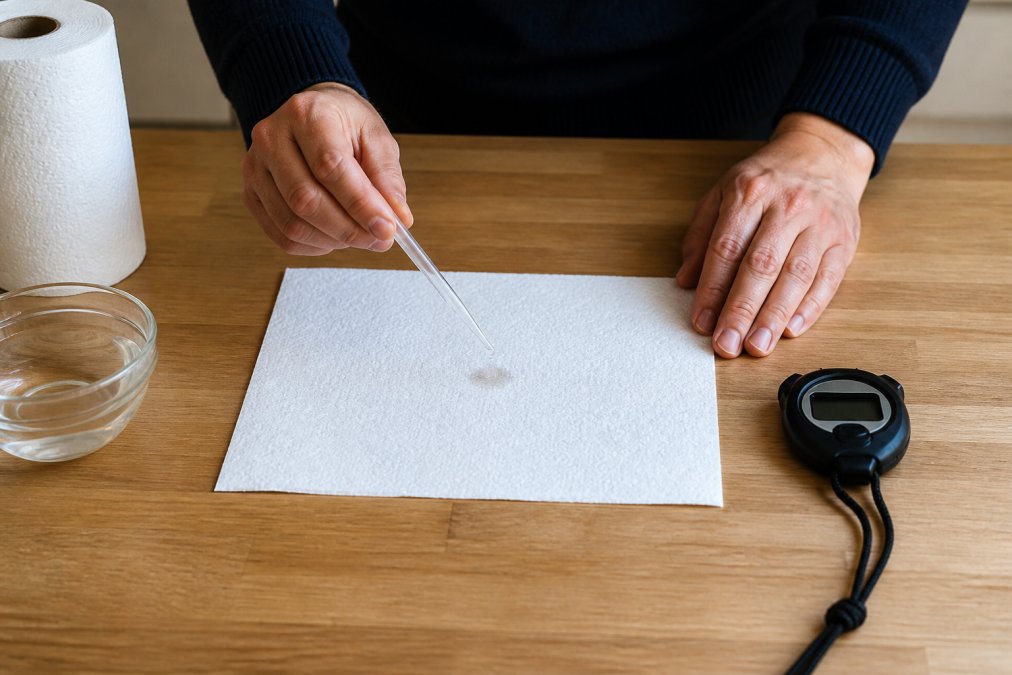
The Water Drop Test
The water drop test measures how quickly a towel pulls water in. Speed matters most for small spills.
Here is how to run it:
- Lay one sheet flat on your board.
- Fill a small cup with room-temperature water.
- Drop a single teaspoon of water onto the centre of the sheet.
- Start your timer the moment the drop lands.
- Stop it when the wet patch stops growing.
- Note the time in seconds.
- Repeat three times on fresh sheets and average the results.
A fast towel wicks the drop in within a few seconds. A slow one leaves a bead sitting on the surface.
The Submersion and Drain Test
The submersion and drain test measures total capacity. This shows how much water a full sheet can hold before it gives up.
Follow these steps:
- Weigh a dry sheet on your scale. Note the figure.
- Hold the sheet under water for ten seconds.
- Lift it out and let it drain for thirty seconds.
- Weigh the wet sheet.
- Subtract the dry weight from the wet weight.
The difference is the water the towel held, in grams. A higher figure means more capacity. Run this twice and average the numbers for a fair reading.
| Test | What It Measures | Time Needed | Best For |
|---|---|---|---|
| Water drop | Absorption speed | Under 1 minute | Small spills |
| Submersion and drain | Total water capacity | About 2 minutes | Large spills |
| Ply check | Layer count and strength | 1 minute | Wet wiping |
| Wet strength pull | Tear resistance when wet | 1 minute | Scrubbing tasks |
Kitchen Towel Ply and Absorbency: Does Thicker Mean Better?
More ply does not always mean more absorbency. Ply is the number of layers bonded into one sheet. A 3-ply towel usually holds more water and resists tearing, but only if the paper itself is well made.
Here is the catch. Some makers bulk up a cheap sheet with air and texture to make it feel thick. It looks plush and fails on contact. Real absorbency comes from fibre quality, not layer count alone.
Check ply by pulling a sheet apart at the corner. You should see distinct layers. If it separates into a thin film, the ply count on the pack is doing more marketing than work.
For heavy jobs like wiping a hob or soaking up a pan, 3-ply earns its place. For light dusting, a 2-ply sheet does the job fine. Match the ply to the task rather than buying the thickest roll on the shelf.
Factors Affecting Kitchen Roll Performance
Several factors affecting kitchen roll performance decide how a towel behaves in your hand. Ply is only one of them. Fibre type and surface texture do just as much work.
Material Quality and Fibre Type
Virgin pulp fibres are long and strong. They form a dense web that pulls water in and holds it. Recycled fibres are shorter, so the sheet absorbs less and breaks down faster when wet.
You can spot the difference in use. A virgin pulp towel stays intact when you wipe a wet surface. A weaker sheet pills and leaves bits behind.
Leaora uses 100% virgin pulp parent reels for exactly this reason. Longer fibres mean a stronger sheet that keeps its shape when wet.
Embossing and Texture
Embossing presses a pattern into the sheet. The raised areas increase surface area, which helps the towel grab water faster. It also adds bulk without extra paper.
Quilted patterns tend to work well for large spills. Dense dot patterns suit scrubbing. A smooth sheet with no texture absorbs more slowly, though it can still hold a good amount of water.
Texture is easy to test. Run your finger across a dry sheet. If you feel raised ridges, the towel has been embossed. That is usually a good sign.
Common Mistakes to Avoid When Testing Paper Towel Absorbency
Most home tests fail for the same handful of reasons. Avoid these and your results will actually mean something.
- Testing one sheet only. Paper varies across a roll. Run three sheets and average them.
- Using cold water. Cold water moves more slowly through paper and drags your timings out.
- Skipping the drain time. Weighing a soaking sheet without draining gives a false high reading.
- Judging by thickness alone. A thick sheet can still be a poor absorber.
- Ignoring wet strength. A towel that tears when wet is useless, no matter how much it holds.
- Comparing different sheet sizes. Match sheet dimensions or your capacity figures mean nothing.
Run your tests on the same day, with the same water, and note every result. Patterns show up fast once you have real numbers in front of you.
Verifying paper towel absorbency comes down to two simple tests and a bit of patience. Most shoppers never run them, which is why so many rolls disappoint once they get home. If you would rather skip the guesswork, Leaora makes the choice easy. We produce premium kitchen towels from 100% virgin pulp at our own converting facility, using precision rewinding machinery for a consistent finish on every roll. Our direct-from-manufacturer supply keeps stock reliable for homes and businesses alike. Choose Leaora for kitchen towels built to hold up on the jobs that matter.
Frequently Asked Questions
What is the best way to test the absorbency of a paper towel?
The water drop test is the simplest method. Place a single drop of water on a flat sheet of kitchen towel and time how long it takes to absorb completely. A quality towel absorbs within 2-3 seconds. For a more thorough check, try the submersion test: weigh a dry sheet, soak it in water for 30 seconds, let it drain for 30 seconds, then weigh it again. The difference in grams shows how much water that sheet holds.
Does the number of plies affect kitchen towel absorbency?
Yes, but not in the way most people assume. Ply refers to how many layers are bonded together. A 3-ply towel has three layers, which creates more internal surface area to trap water. However, a poorly made 3-ply towel can underperform a well-made 2-ply one. The bonding quality and fibre type matter as much as the ply count. When testing kitchen towel ply and absorbency, always compare towels made from similar materials to get a fair result.
How do you measure the water retention capacity of kitchen roll?
Use a kitchen scale accurate to 1 gram. Weigh a dry sheet and record the figure. Submerge the sheet fully in a bowl of water for 30 seconds, then hang it to drain for 30 seconds. Weigh the wet sheet. Subtract the dry weight from the wet weight. The result, in grams, is the water retention capacity. A sheet weighing 5g dry that weighs 45g wet holds 40g of water. Test three sheets from the same roll and average the results.
What factors influence the absorbency of paper products?
Several factors affect kitchen roll performance. Fibre type is the biggest: virgin pulp fibres are longer and create more space for water than recycled fibres. Embossing increases surface area, which helps water spread and absorb faster. Ply count adds layers and capacity. Compaction during manufacturing reduces the gaps between fibres, lowering absorbency. Even storage conditions matter; damp storage can pre-saturate the paper and reduce how much it holds when you need it.