

Table of Contents
- What Makes Paper Products for Offices Sustainable?
- Recycled Paper for Offices: Where It Performs and Where It Doesn't
- FSC-Certified Paper: What the Label Actually Guarantees
- Eco-Friendly Toilet Paper for Businesses: What to Check Before You Bulk Buy
- How to Reduce Paper Waste at Work Without Adding Admin
- Common Mistakes When Switching to Sustainable Paper Products
- Frequently Asked Questions
Last Updated: 9 October 2026
What Makes Paper Products for Offices Sustainable?
Sustainable paper products for offices are tissue and paper goods made in a way that limits environmental harm across their whole life cycle, from the fibre source to the mill that converts it. In practice, that means two things matter most: where the fibre comes from, and who turns it into the roll you actually use. At Leaora, we manufacture tissue from 100% virgin pulp parent reels at our own converting facility, which gives us direct control over both.
Most buying guides treat "sustainable" as a single badge you either have or don't. That's the wrong mental model, and it's why so many procurement decisions go awry.
Recycled content versus virgin pulp
Recycled content reduces demand for new fibre, and for high-volume, low-touch uses it's often the sensible default. Virgin pulp, by contrast, uses new fibre but typically produces a stronger, more absorbent sheet with fewer breakages in dispensers.
The trade-off isn't moral, it's operational. A washroom roll that tears mid-use creates waste, complaints and callouts. Where strength matters, virgin pulp earns its place.
Certification, chain of custody and British manufacturing
Chain of custody is the documented trail showing fibre moved from a certified forest through every handler to the finished product. Without it, a logo on a box proves very little.
The Forest Stewardship Council's certification standards set out what that trail must contain. Separately, making tissue domestically shortens the supply chain and keeps more of the value here, which matters when you're committing to a regular order.
Recycled Paper for Offices: Where It Performs and Where It Doesn't
Recycled paper for offices performs best in high-volume, low-prestige roles: general printing, hand towels, and washroom tissue where the sheet isn't under load. It struggles where strength and finish are non-negotiable, such as executive washrooms or anywhere a dispenser jam causes a real problem.
Here's the honest breakdown:
- Best for: high-traffic washrooms, back-office printing, janitorial stock
- Weaker for: premium client-facing washrooms, high-absorbency kitchen tasks
- Watch for: inconsistent sheet thickness between batches, which shows up as dispenser jams
A common mistake is assuming recycled always means lower quality. That's not true across the board. What is true is that recycled fibre behaves differently, and your dispensers need to suit it.
FSC-Certified Paper: What the Label Actually Guarantees
FSC-certified paper guarantees that the fibre in a product can be traced to a responsibly managed source, verified through an independent chain-of-custody audit. It does not guarantee the paper is recycled, nor that it will perform well in your dispensers.
There are different FSC labels, and they mean different things. The FSC label descriptions explain each type, and it's worth five minutes before you sign a contract.
What most buyers miss is that certification covers the fibre, not the finished roll. Strength, ply and sheet count are separate specifications you still have to check yourself.
Eco-Friendly Toilet Paper for Businesses: What to Check Before You Bulk Buy
Eco-friendly toilet paper for businesses should be judged on ply, parent reel quality and sheet strength, not on softness marketing. Softness claims are unregulated and easy to make. Strength and ply are measurable.
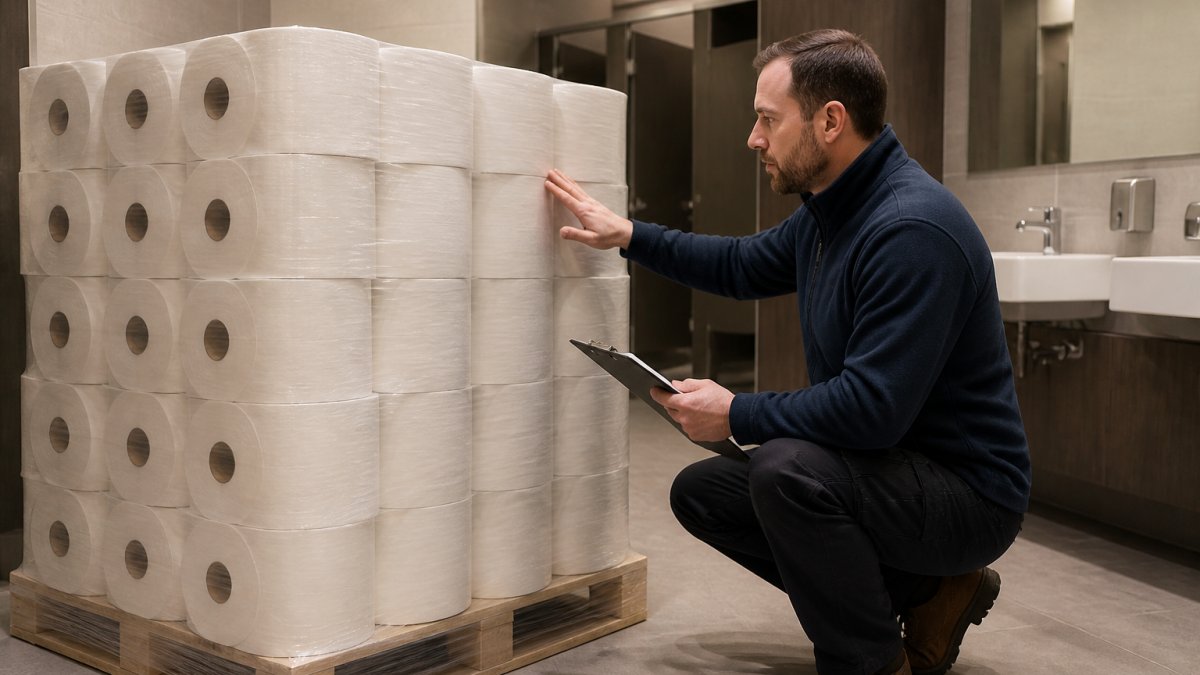
Before you commit to a pallet order, confirm:
- Ply: 2-ply suits most washrooms; 3-ply holds up better in heavy-use sites
- Parent reel source: where the base tissue came from, and whether it's consistent
- Sheet count per roll: a lower count at a lower price is not a saving
- Dispenser compatibility: roll diameter and core size must match your units
- Reorder lead time: how quickly a repeat order actually lands
Ply, parent reels and why strength matters more than softness claims
A parent reel is the large jumbo roll of base tissue a converter buys before cutting it into finished rolls. Its quality sets the ceiling on everything downstream.
Thin, weak parent stock produces rolls that shred in the dispenser. That's not a minor annoyance. It drives up consumption, because people pull more sheets to compensate. Strength is the cost-saving specification, and softness is the one that sells.
How to Reduce Paper Waste at Work Without Adding Admin
Reducing paper waste at work comes down to three levers: what you buy, how it's dispensed, and how often you review usage. None of them require a new role or a software rollout.
Start with a short monthly audit. It takes about fifteen minutes and it catches most waste.
A simple monthly paper audit for smaller offices
Run this on the same day each month:
- Count rolls remaining in each washroom and compare to last month
- Note any dispenser jams or torn sheets reported by staff
- Check whether any product is being double-stocked "just in case"
- Confirm the reorder quantity still matches actual usage
- Flag any product that consistently underperforms
That's it. The pattern shows up within two or three cycles.
| Problem spotted | Likely cause | Fix |
|---|---|---|
| Rolls run out mid-week | Reorder quantity too low | Raise standing order |
| Frequent dispenser jams | Roll size or ply mismatch | Switch specification |
| Usage climbing with no headcount change | Weak sheet, over-pulling | Move to stronger ply |
| Overstock in storage | Ordering on habit, not data | Trim to measured usage |
Common Mistakes When Switching to Sustainable Paper Products
The biggest mistake is switching on the label alone. Buyers check for a certification mark, sign the contract, and discover three months later that the sheet is too thin for their dispensers. Certification says nothing about performance.
Other recurring errors:
- Changing everything at once. Swap one product line first, measure it, then move the next.
- Ignoring dispenser compatibility. A cheaper roll that jams costs more than the one it replaced.
- Buying on unit price only. Cost per sheet used matters more than cost per pack.
- Assuming local means slower. Domestic manufacturing often shortens lead times, not lengthens them.
- Skipping the trial. Order a small quantity before committing to a pallet.
What most guides miss is that the switch is a supply chain decision, not a values decision. Get the specification right and the sustainability follows.
Choosing sustainable paper products for offices is really a question of supplier reliability. Certification, ply and fibre source all matter, but none of them help if the stock doesn't arrive when you need it. Leaora manufactures tissue from 100% virgin pulp parent reels at our own converting facility, using precision 1400mm semi-automatic rewinding machinery for a consistent finish, and supplies both households and commercial clients direct from the manufacturer. That direct route is what keeps the supply chain dependable. Choose Leaora for your next order and get a consistent, retail-ready paper supply you can plan around.
Frequently Asked Questions
What are the most sustainable paper products for an office?
The strongest options combine high recycled content with credible certification. For printing, look for paper carrying the FSC Recycled label, which verifies both the fibre source and the chain of custody. For washrooms, eco-friendly toilet paper for businesses made from recycled or responsibly sourced pulp reduces pressure on virgin fibre. Durability also matters: a paper that tears or clogs gets replaced faster, which cancels out much of the environmental gain. Check the label, the ply and the supplier's ability to restock consistently before committing to bulk volumes.
What does FSC-certified paper mean?
FSC-certified paper carries a label from the Forest Stewardship Council, an international scheme that sets standards for responsible forest management. The FSC 100% label means all fibre comes from certified forests. FSC Recycled means the fibre is reclaimed material. FSC Mix combines certified, recycled and controlled wood. For an office buyer, the practical point is traceability: the certificate covers the whole chain from forest to finished ream or roll, so you can verify the claim rather than take a supplier's word for it.
How can an office reduce paper waste?
Start by measuring. A one-month audit of print volumes, washroom consumption and towel usage shows where the waste actually sits. Then set defaults: double-sided printing, no automatic cover pages, and digital approval workflows for internal documents. In washrooms, switch to dispensers that release a fixed sheet length, which typically cuts consumption compared with open rolls. Finally, brief staff once on the changes rather than issuing repeated reminders, and review the numbers quarterly to confirm the reduction is holding.
Are bamboo paper products more sustainable than recycled paper?
It depends on the supply chain rather than the material alone. Bamboo grows quickly and needs less land, but much of it is shipped long distances, which adds transport emissions. Recycled paper for offices keeps material in circulation and usually travels shorter distances if it is converted locally. Neither option is automatically better. Ask where the fibre is sourced, how far it travels, and whether the finished product carries certification. A locally converted recycled product often wins on total impact.